
No. Tubing mascara does not contain real spider legs. The phrase “spider legs” usually describes a makeup look in which lashes appear long, stiff, separated, or clumped together.
Tubing mascara gets its name from the way it wraps each lash in a thin tube-like film. Some formulas also contain tiny fibers that add length. Those fibers may create a spidery look if too much product is applied, but they are not spider parts or animal legs.
For shoppers in the United States, mascara is regulated as a cosmetic by the U.S. Food and Drug Administration (FDA). Cosmetic ingredients must be safe for their intended use, and products must not contain harmful contaminants. Still, each formula is different, so reading the ingredient list matters.

What does “spider legs” mean in mascara?
“Spider legs” is a beauty term for lashes that look very thick, clumped, sharp, or heavily coated. The lashes may stick together in small groups, which can make them resemble spider legs.
The term does not describe a standard mascara ingredient. It is usually one of these things:
- A makeup style with dramatic, clumped lashes
- A result caused by applying too many coats
- The effect of lash-lengthening fibers
- A description of stiff, pointed lash tips
- A complaint about mascara that flakes or creates uneven clumps
The look can be intentional. Some people like bold, editorial lashes. Others want soft, separated lashes and may see the same effect as a problem.
Why do lashes look spidery?
Mascara can create this effect when:
- Several lashes stick together.
- A thick layer dries on the lash surface.
- Fibers extend beyond the natural lash tips.
- The formula dries before you comb through it.
- A second coat is added after the first coat has fully set.
- The wand deposits too much product.
Tubing mascara may make the effect more noticeable because its film can dry into a firm coating around each lash. That does not mean the formula contains anything unusual or unsafe by default.

How does tubing mascara work?
Tubing mascara uses film-forming ingredients that wrap around individual lashes. When the product dries, these ingredients create small coatings that look and feel like tubes around the lashes.
The exact formula varies by brand. Common ingredient types may include:
- Film-forming polymers
- Water-based solvents
- Waxes or conditioning agents
- Pigments, such as iron oxides
- Preservatives
- Fibers in some lengthening formulas
A tubing formula is different from a traditional wax-based mascara. Traditional mascara often paints color onto the lash with waxes, oils, and pigments. Tubing mascara relies more heavily on a flexible film that grips the lash.
This design may help reduce smudging under the eyes. It can also make removal easier because the dried film may slide off with warm water and gentle pressure.
Are the “tubes” actual plastic tubes?
No. The tubes are not pre-made pieces of plastic placed on your lashes. They form when the liquid mascara dries around the lash.
Think of it like a thin sleeve that forms around each lash. The sleeve is made from the product’s film-forming ingredients. It is not a hard tube, hollow straw, or animal-derived part.
A tubing mascara may contain synthetic polymers. However, “synthetic” does not automatically mean unsafe. Safety depends on the ingredients, their amounts, how the product is used, and whether the product is contaminated.
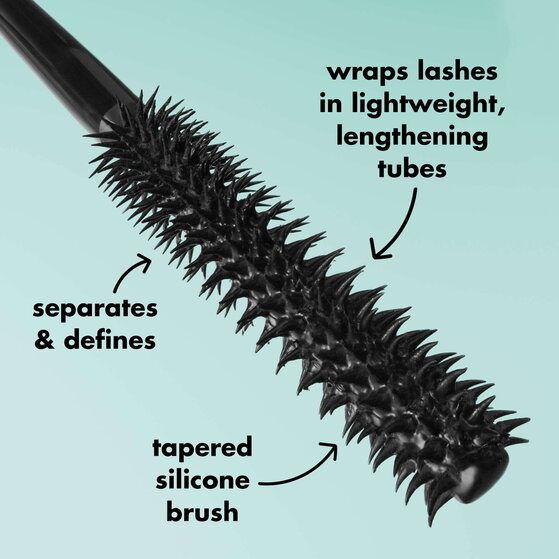
Can tubing mascara contain fibers?
Yes, some tubing mascaras contain fibers, but not all of them do.
Fiber mascara uses small particles to make lashes look longer or fuller. These particles may be made from materials such as nylon, rayon, or other cosmetic fibers. The material depends on the product.
Fibers attach to the lash and extend beyond its natural tip. If several fibers stick together, the result can look like sharp, thin “spider legs.”
This is different from saying the mascara contains spiders or spider legs. The word “fiber” refers to the shape and function of the cosmetic material, not its animal source.
Check the ingredient list or the product label if you want to know whether a formula contains fibers. Marketing terms such as “lengthening” or “false-lash effect” do not always tell you whether fibers are present.
Tubing mascara versus fiber mascara
These terms can overlap, but they describe different features:
| Feature | Tubing mascara | Fiber mascara |
|---|---|---|
| Main action | Forms a film around lashes | Adds small particles to increase apparent length or volume |
| Typical removal | May slide off with warm water | Often needs the cleanser listed by the brand |
| Main visual effect | Defined, coated lashes | Longer or fuller-looking lashes |
| Can create a spidery look? | Yes, if overapplied | Yes, especially when fibers clump |
| Contains fibers? | Sometimes | Usually, if clearly labeled as fiber mascara |
A product can be both tubing and fiber-based. The label, ingredient list, and manufacturer instructions provide the best answer for a specific mascara.

Why does tubing mascara sometimes look clumpy?
Tubing mascara can look clumpy for the same basic reasons as other mascaras. The main issue is usually product buildup, not unusual ingredients.
Common causes include:
- Applying too many coats
- Using a wand with too much product on it
- Waiting too long between coats
- Using an old or dried-out tube
- Pumping the wand into the tube, which can push in air
- Applying mascara to lashes that already have oil, cream, or powder on them
- Using a formula that is too thick for your preferred look
A small amount of clumping can create a defined, bold style. Heavy clumping may make lashes feel stiff or look uneven.
How to prevent a spider-leg look
Try this simple method:
- Start with clean, dry lashes. Remove oil, eye cream, and makeup residue.
- Wipe excess mascara from the wand. Use the tube’s opening rather than a tissue, since tissue fibers can contaminate the wand.
- Apply one thin coat. Move the wand from the lash base toward the tips.
- Separate lashes while the mascara is still workable. Use a clean lash comb if needed.
- Add a second coat only if the product allows it. Follow the brand’s directions.
- Do not keep brushing once the product has fully dried. This can create flakes and uneven buildup.
If you want a natural look, choose a tubing mascara described as defining or separating rather than volumizing or fiber-lengthening.

Is tubing mascara safe for your eyes?
Tubing mascara can be safe when used as directed, but no eye product is risk-free for every person. Some people may react to a preservative, pigment, fragrance, or other ingredient.
The FDA advises consumers to avoid eye cosmetics that cause irritation and to avoid sharing eye makeup. The agency also recommends replacing mascara regularly because the wand repeatedly contacts the eye area and can introduce bacteria into the product.
Stop using the mascara if you notice:
- Burning or intense stinging
- Redness
- Swelling
- Itching
- Eye pain
- Unusual discharge
- Blurred vision
- A rash around the eyelids
Do not try to “push through” eye irritation. Rinse the eyes with clean water if product enters the eye, and seek medical care if symptoms are severe, persistent, or affect your vision.
People with contact lens needs, sensitive eyes, blepharitis, eczema, or a history of cosmetic reactions may need extra care. A qualified eye-care professional or medical provider can offer advice based on your symptoms and health history.
Does tubing mascara contain animal parts?
There is no general rule that tubing mascara contains animal parts. Most tubing formulas use cosmetic polymers and pigments, but brands may use different ingredients.
Some mascaras may contain ingredients that raise vegan concerns, such as beeswax, carmine, or other animal-derived materials. A formula can also be cruelty-free without being vegan. These terms do not mean the same thing:
- Vegan: The product does not contain animal-derived ingredients, according to the brand’s stated standard.
- Cruelty-free: The brand states that the product and its ingredients were not tested on animals, subject to the brand’s certification or policy.
- Plant-based: Some or most ingredients come from plants; this does not always mean the entire product is vegan.
Look for a clear vegan statement, certification, or full ingredient list. Contact the manufacturer if the label does not answer your question.

How do you remove tubing mascara?
Many tubing mascaras are designed to loosen with warm water and gentle pressure. The product may come away in small tubes or flakes. This can look strange, but it does not mean your eyelashes are falling out.
Use this basic removal method unless the brand gives different instructions:
- Wet your lashes with comfortably warm water.
- Hold a wet cloth or clean fingertips over the lashes for several seconds.
- Gently press and slide the softened mascara away.
- Do not pull hard or scrub the eyelids.
- Rinse away any remaining product.
- Pat the area dry without rubbing.
Some formulas may need a cleanser or makeup remover. Read the product label first, especially if the mascara is waterproof, hybrid, or contains fibers.
What if the mascara will not come off?
If tubing mascara does not loosen with warm water, possible reasons include:
- It is not a true tubing formula.
- The brand requires an oil-based or two-phase remover.
- The product has been layered with another mascara.
- The mascara has mixed with eyeliner, primer, or eye shadow.
- The coating has dried heavily on the lashes.
Do not tug at the lashes. Use the removal product recommended by the manufacturer. If removal causes pain or pulls out lashes, stop and ask a medical professional or eye-care provider for help.
Tubing mascara pros and cons
Tubing mascara may suit people who want less smudging and a simpler removal routine. It may not suit people who prefer a soft, creamy, highly buildable formula.
| Possible benefit | Possible limitation |
|---|---|
| May resist some smudging | Some formulas can feel stiff |
| Often removes with warm water | Not every formula removes the same way |
| Can define individual lashes | May look clumpy if overapplied |
| Often works well for lower lashes | Some formulas provide less dramatic volume |
| May leave fewer dark flakes under the eyes | Fibers can create a spidery look |
The best choice depends on your goal. For clean definition, use a thin coat and a separating wand. For bold length, a fiber formula may help, but it may also create more visible clumps.
Common mistakes to avoid
Mistake 1: Assuming every long fiber is an animal material
A fiber is a cosmetic component, not a spider leg. Check the ingredient list or contact the brand if the material matters to you.
Mistake 2: Applying many coats to already-dry tubing mascara
This can create stiff, pointed clumps. Apply the next coat only when the brand says the formula can be layered.
Mistake 3: Adding water to the mascara tube
Do not dilute mascara with water, saliva, or makeup remover. This can change the formula and increase contamination risk.
Mistake 4: Sharing mascara
Sharing can spread bacteria and other germs near the eyes. Keep mascara personal.
Mistake 5: Keeping the tube too long
Mascara becomes more likely to dry out or become contaminated over time. Follow the package directions and the FDA’s general advice about replacing mascara regularly. Throw it away sooner if it changes smell, texture, or performance.
Mistake 6: Using a dry spoolie from another product
A clean disposable spoolie can help separate lashes, but a used or dirty tool can transfer germs. Use a fresh, clean tool each time.
How to check whether a specific tubing mascara contains fibers
Use this checklist:
- Read the product description for terms such as “fibers,” “fiber lashes,” or “false-lash effect.”
- Review the ingredient list on the package or the brand’s U.S. website.
- Look for fiber-related terms, but remember that ingredient names can vary.
- Check whether the product is described as both tubing and lengthening.
- Ask the manufacturer if the material or vegan status is unclear.
A product claim can explain what the mascara does, but it may not list every material in plain language. The ingredient list is more useful than the phrase “spider lashes,” which is usually only a description of the finished look.
Frequently asked questions
Does tubing mascara have real spider parts in it?
No. Tubing mascara does not normally contain real spiders or spider legs. “Spider legs” describes a clumped or dramatic lash appearance.
Are tubing mascara tubes made of plastic?
The tubes form from film-forming cosmetic ingredients as the mascara dries. They are not pre-made plastic tubes placed on each lash.
Can tubing mascara make lashes look like spider legs?
Yes. Too much product, fiber ingredients, or several thick coats can make lashes look pointed and clumped.
Is tubing mascara better for sensitive eyes?
Not automatically. A tubing formula may be easier to remove, but sensitivity depends on the full ingredient list and the individual user. Stop using it if it causes irritation.
Can you remove tubing mascara with warm water?
Many tubing mascaras are designed to loosen with warm water and gentle pressure. Check the brand’s directions because some hybrid formulas need a makeup remover.
Does tubing mascara damage eyelashes?
Tubing mascara is not automatically damaging. Problems are more likely when a person pulls at the coating, scrubs the eyes, uses contaminated product, or continues using mascara that causes irritation.
Final answer
Tubing mascara does not have spider legs in it. The phrase refers to a lash look, not a literal ingredient. Tubing mascara forms a film around the lashes, and some formulas add fibers for extra length. Those features can create a spidery appearance when the product is layered or clumps.
For the safest choice, check the ingredient list, follow the removal instructions, avoid sharing mascara, and stop using the product if it irritates your eyes.
